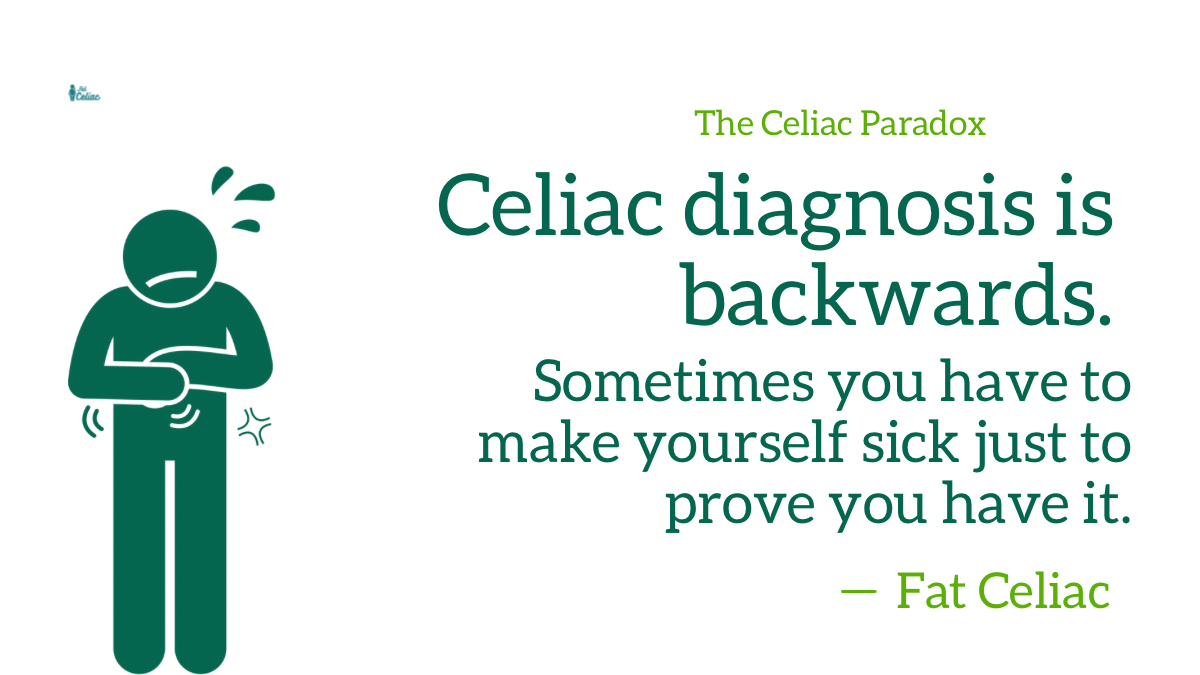
To prove you have celiac disease, you often have to do the very thing that is damaging your body:
Eat gluten.
That sounds backwards, because most of the time when something hurts us, the solution is simple — stop doing the thing that hurts.
If you go to the doctor and say, “This hurts when I do this,” the typical advice is straightforward:
Okay. Stop doing that.
But celiac disease doesn’t work that way.
If someone removes gluten before testing, the autoimmune cascade shuts down. The inflammation decreases. The small intestine begins to heal.
And the evidence of the disease starts to disappear.
Reintroduce gluten, and the immune reaction begins again.
Celiac disease is also unusual because it is one of the only autoimmune diseases where the trigger is known.
Gluten activates the immune response. Remove gluten and the autoimmune activity stops.
In theory, that sounds simple.
In practice, it creates a paradox.
Because the moment someone removes gluten to protect their health, they may also remove the only reliable pathway to diagnosis.
And that pathway can already be long and frustrating.
For many people, it takes ten years or more between the onset of symptoms and an official diagnosis.
Many of us who were born before about 2010 likely lived with celiac disease for decades without knowing it.
Persistent intestinal damage.
Strange and unexplained symptoms.
Doctors searching for answers.
Eventually many people try removing gluten simply to regain some control over a body that feels like it is betraying them.
Sometimes they feel dramatically better.
But by removing gluten, they may also eliminate the very signal doctors rely on to diagnose the disease.
Which can lead to the uncomfortable next step: a gluten challenge — intentionally eating gluten again for weeks so the disease becomes visible in blood tests or biopsy.
That’s the backwards part.
To prove you have celiac disease, you may have to make yourself sick again.
Celiac research is advancing in many areas, but one of the most important needs is better diagnostic testing.
Ideally, tests that do not require weeks of gluten ingestion simply to confirm the disease.
Researchers are exploring alternatives, including short-term gluten challenges and immune response markers, somewhat similar in concept to the gestational diabetes screening used during pregnancy.
These approaches are promising, but they are still years away from routine clinical use.
For now, diagnosis still relies heavily on gluten exposure and intestinal biopsy.
Which leaves many patients caught in a frustrating paradox:
The moment you remove gluten to get healthy, you may also remove the evidence that proves you were sick.
I’m curious about others’ experiences.
Did you have to do a gluten challenge to get diagnosed?
Or were you fortunate enough to be diagnosed the first time testing was done?
Hashtags
#CeliacDisease
#CeliacResearch
#AutoimmuneDisease
#GlutenFreeLiving
#CeliacCommunity
#GlutenFreeLife
#CeliacDiagnosis

Leave a Reply