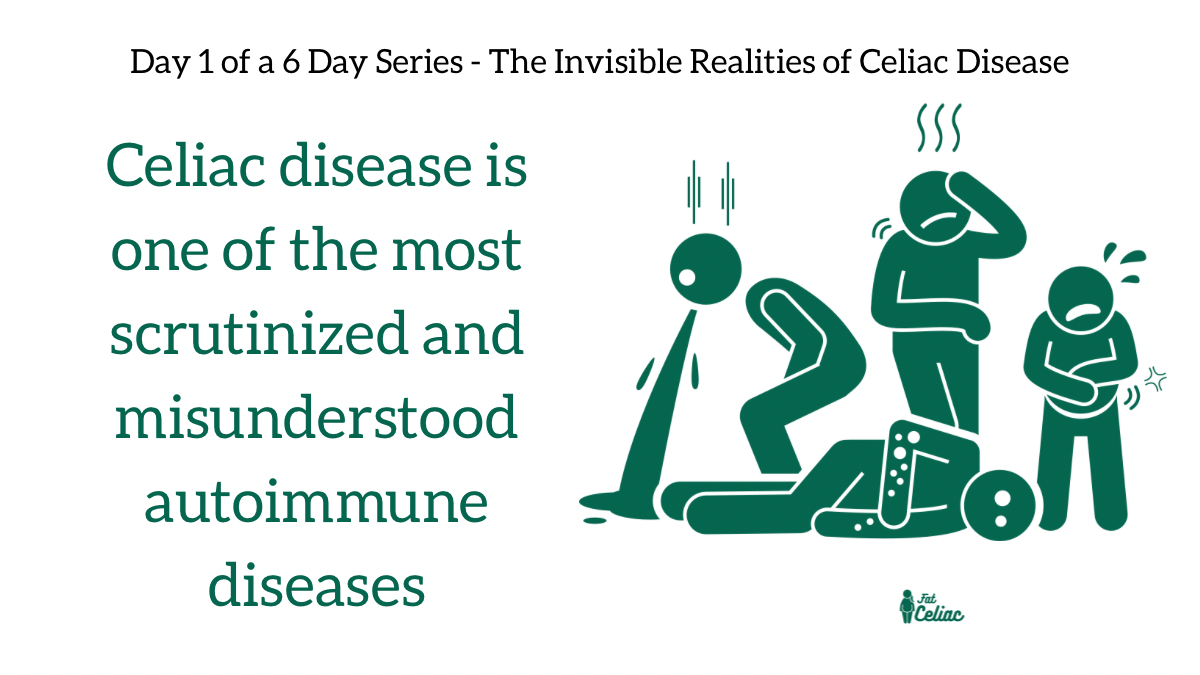
Celiac disease is invisible—and it is one of the most scrutinized and misunderstood autoimmune diseases.
By scrutinized, I don’t mean by doctors or specialists. I mean by strangers. By acquaintances. By well-meaning friends. By people at dinner tables, restaurants, school events, work lunches, and family gatherings.
Most invisible illnesses allow for privacy.
Celiac disease does not.
We eat three meals a day and usually two snacks. At each of those five moments, there is a point—sometimes subtle, sometimes very public—where we have to disclose our disease. We don’t get to opt out. We don’t get to rest quietly with it. We have to announce it, often repeatedly, and then stand there while people decide whether they believe us.
My personal favorite is still:
“Oh, are you trying to lose weight with that lettuce wrap?”
Nope. I’m trying not to spend the next three days exhausted, inflamed, and stuck in the bathroom. I’m trying to avoid triggering an immune response that damages my small intestine and takes weeks—or longer—to fully recover from. I’m also trying to make peace with the frankly absurd idea that a handful of lettuce is a reasonable substitute for your soft, pillowy, gluten-filled bun.
So yes. I’m really enjoying the heck out of this lettuce wrap.
(Please imagine my voice dripping with sarcasm.)
But the food itself is only part of it.
What really wears you down is the explaining. The defending. The constant sense that you are on trial for managing your own health.
“Celiac disease isn’t real.”
“Gluten intolerance is just made up.”
“People didn’t have this 50 years ago.”
Okay. My gut would strongly disagree. And I don’t recall ever telling someone their cancer wasn’t real because it wasn’t commonly diagnosed decades ago. Whether you believe celiac disease or gluten intolerance is real is irrelevant. My health is not determined by popular opinion, internet skepticism, or your cousin’s Facebook research.
And then there are the people who want proof.
“Just a little won’t hurt.”
“Try a bite and see what happens.”
“It’s homemade—it’s fine.”
This is the part people don’t understand: celiac disease isn’t invisible because nothing is happening. It’s invisible because we’ve learned to carry it quietly. We’ve learned how to say no politely. We’ve learned how to smile through awkwardness. We’ve learned how to absorb discomfort so others don’t have to feel it.
But here’s the truth I wish more people understood—and that I want you to hear clearly:
You do not owe anyone an explanation.
You do not owe anyone proof.
You do not owe anyone access to your body as an experiment.
If someone’s feelings are hurt because you didn’t eat their cake, that discomfort belongs to them—not you. Your health is more important than social niceties. Full stop.
What makes celiac disease uniquely difficult isn’t just that it’s invisible. It’s that its invisibility invites commentary, judgment, and negotiation in a way few other autoimmune diseases do. Our illness lives on the plate, and because of that, people feel entitled to weigh in.
This series isn’t about ranking suffering. It’s about naming reality.
Tomorrow, we’re talking about why celiac disease is the only autoimmune disease people routinely treat like a preference—and why that misunderstanding causes real harm.
If this resonated, you’re not alone. And if you’ve ever felt exhausted not from symptoms, but from managing other people’s opinions, this space is for you.
Leave a Reply