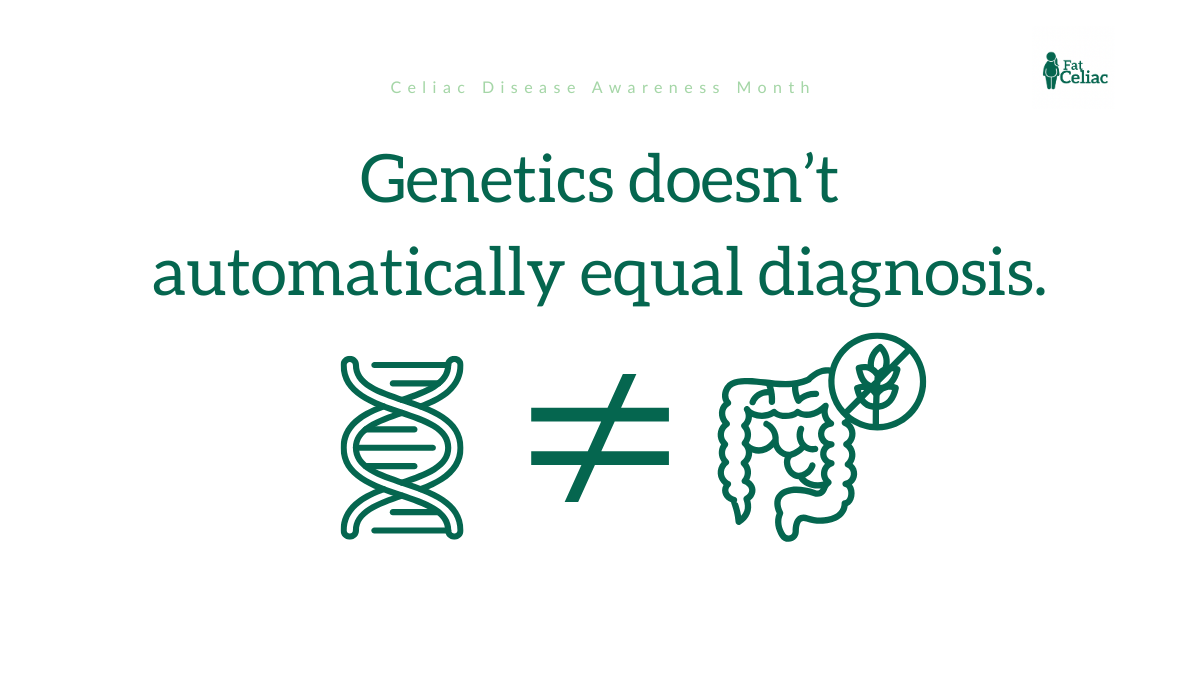
Celiac disease is strongly influenced by genetics. If you carry the genetic markers for celiac disease, you have the possibility of developing celiac disease.
But it is not guaranteed.
About 30–40% of the population carries the genetic markers associated with celiac disease, but only a small percentage of people ever develop the disease itself.
And even the prevalence of celiac disease varies by geography. Population-based screening studies have found rates ranging from about 0.9% in Oregon to 1.5% in Italy to as high as 2.4% in parts of Colorado.
Genetics matter.
But they are not the whole story.
Celiac disease also tends to travel with other autoimmune diseases.
When people say, “I’m the first person in my family with celiac disease,” I usually tell them to look back through the family history for Hashimoto’s Thyroiditis (autoimmune thyroid disease) or Type 1 Diabetes. Those diseases are closely associated with celiac disease and often travel in the same genetic circles.
For me, I had a great-grandmother and cousin with Type 1 Diabetes. My sister has Hashimoto’s disease. My grandparents on my mother’s side both had significant stomach issues.
My mother has two copies of HLA-DQ2.5 — one inherited from each parent — and no celiac disease.
After my diagnosis, my grandfather told his doctor and asked to be tested for celiac disease. The doctor reportedly told him that at 82 years old, it did not matter anymore.
Fair.
Frustrating.
And probably medically reasonable.
But from a purely selfish perspective, I would have liked to know.
As a side note, a long time ago, my grandmother once fainted and was in a coma of unknown origin for two weeks. During testing, doctors found significant malnutrition.
She almost certainly carried the genetic markers because she passed them to my mother.
Could it have been because she lived primarily on Butterfinger bars, coffee, and cigarettes while sitting in her mad corner watching the Braves on TBS?
Possibly.
Could it have been undiagnosed active celiac disease?
That has always been my working theory.
But we will never know because she died in 1998.
Genetics matter in celiac disease.
But they are only part of the story.

Leave a Reply