
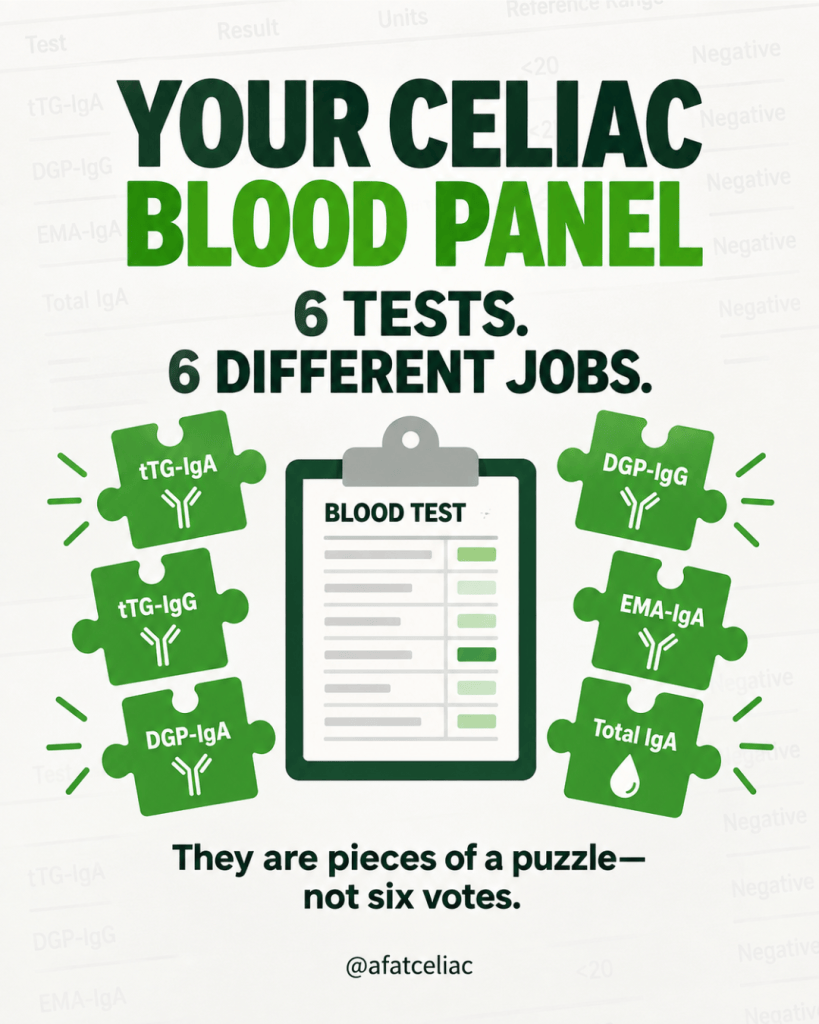


Your celiac blood panel is not six versions of the same test.
Each test has a different job.
You cannot count the positive and negative boxes and let the majority decide. You have to read the results together.
Here is the plain-English version.
1. Total IgA: Start here
Total IgA is not a celiac antibody.
It tells us whether your body makes enough IgA for the IgA-based tests to work.
If your total IgA is low, tests like tTG-IgA, DGP-IgA and EMA-IgA may stay negative—even if you have celiac disease.
That does not mean the tests failed. Your body may not make enough IgA to produce a positive result.
When total IgA is low, the IgG tests become more important.
2. tTG-IgA: The main screening test
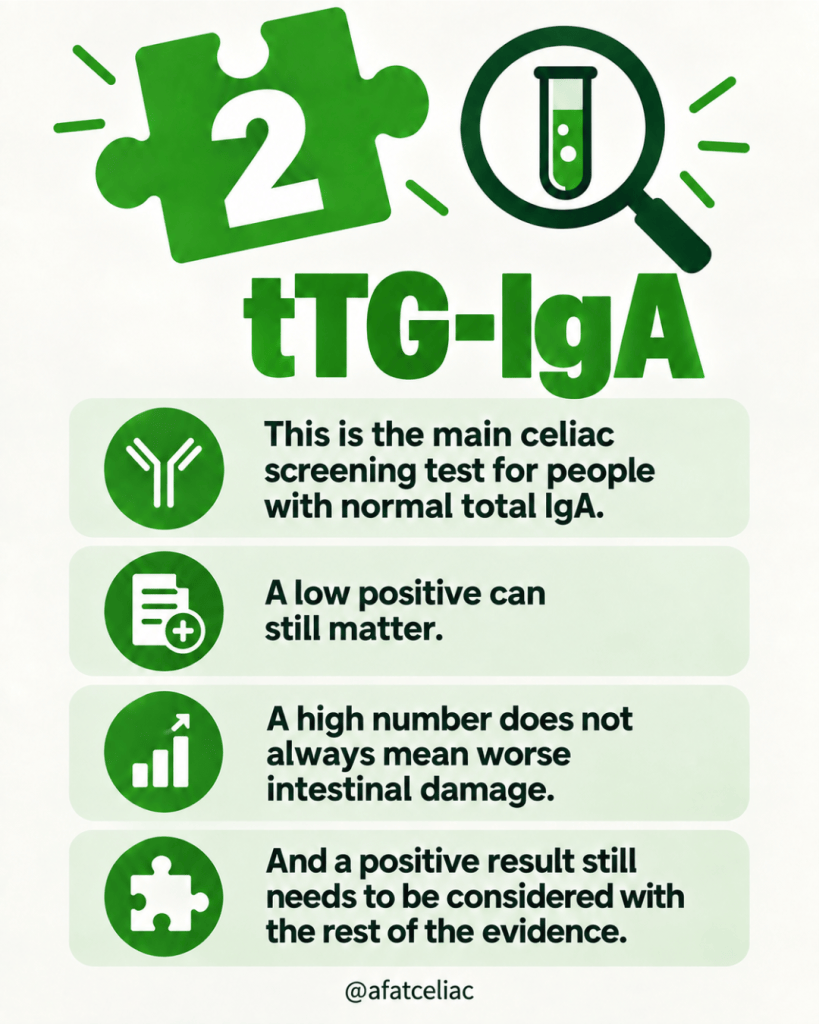
For people with normal total IgA, tTG-IgA is the main blood test used to look for celiac disease.
A low positive is a positive and requires additional scrutiny.
People with low positive numbers can have significant intestinal damage. People with high positives can have less damage.
But a positive result does not confirm celiac disease by itself.
Low positive results can sometimes happen with other autoimmune or inflammatory conditions. Temporary positives can also happen around an illness, especially in children.
That is why the actual number, the laboratory’s normal range and the other test results all matter.
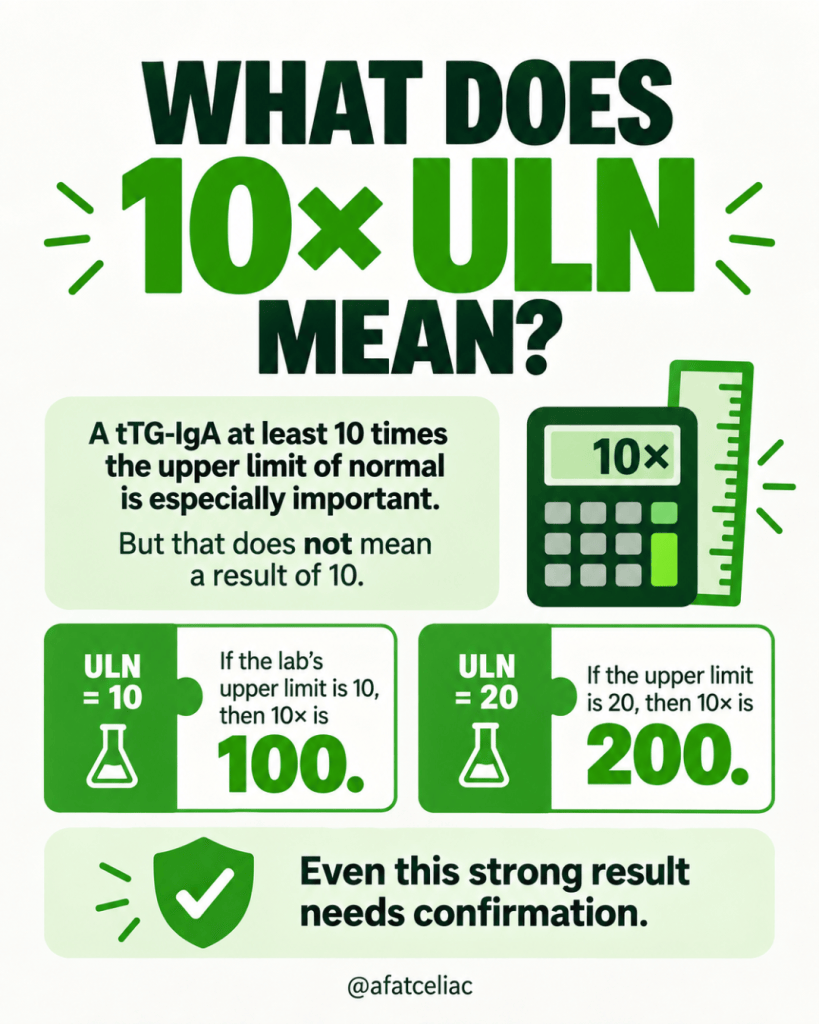
A tTG-IgA result at least 10 times the upper limit of normal is especially important.
If the lab says normal is below 10, then 10 times the upper limit is 100.
If the lab says normal is below 20, then 10 times the upper limit is 200.
Even a result that high needs to be confirmed with more information or confirmed with another TTG IGA at a different time.
3. tTG-IgG: Most useful when total IgA is low
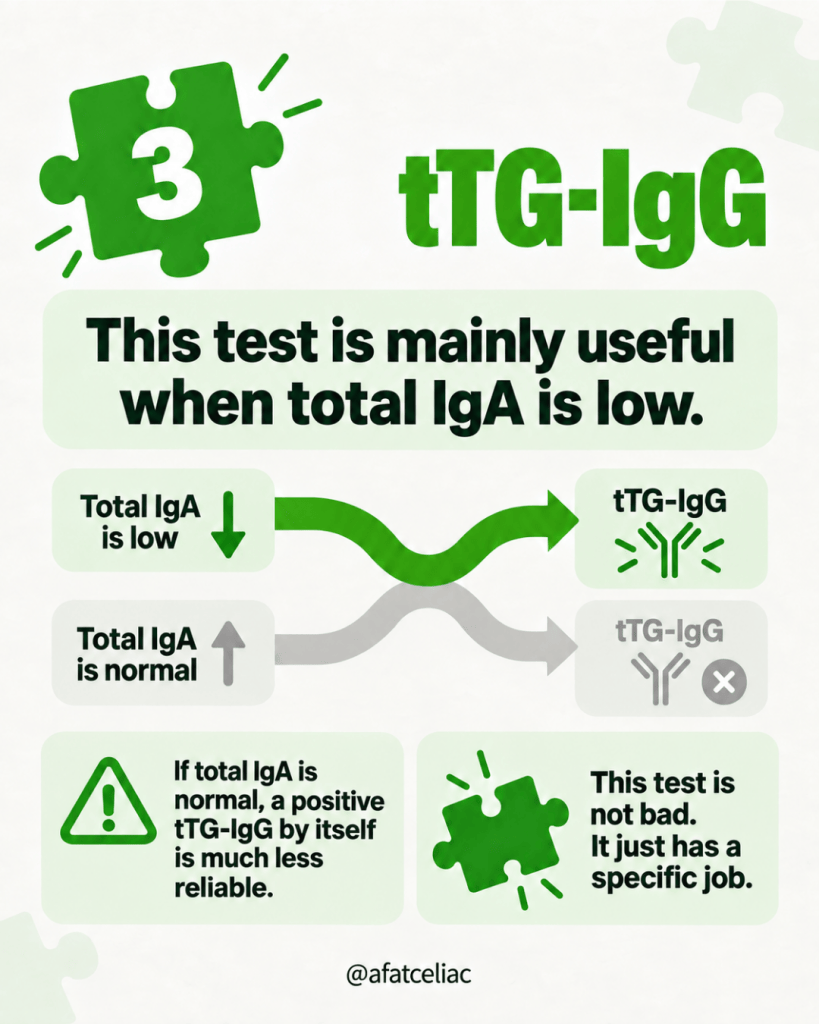
This test is mainly used when someone does not make enough IgA.
If total IgA is normal, a positive tTG-IgG by itself is much less reliable.
Even when total IgA is low, tTG-IgG is not as accurate as tTG-IgA is in someone with normal IgA.
This test is not bad. It simply has a very specific job.
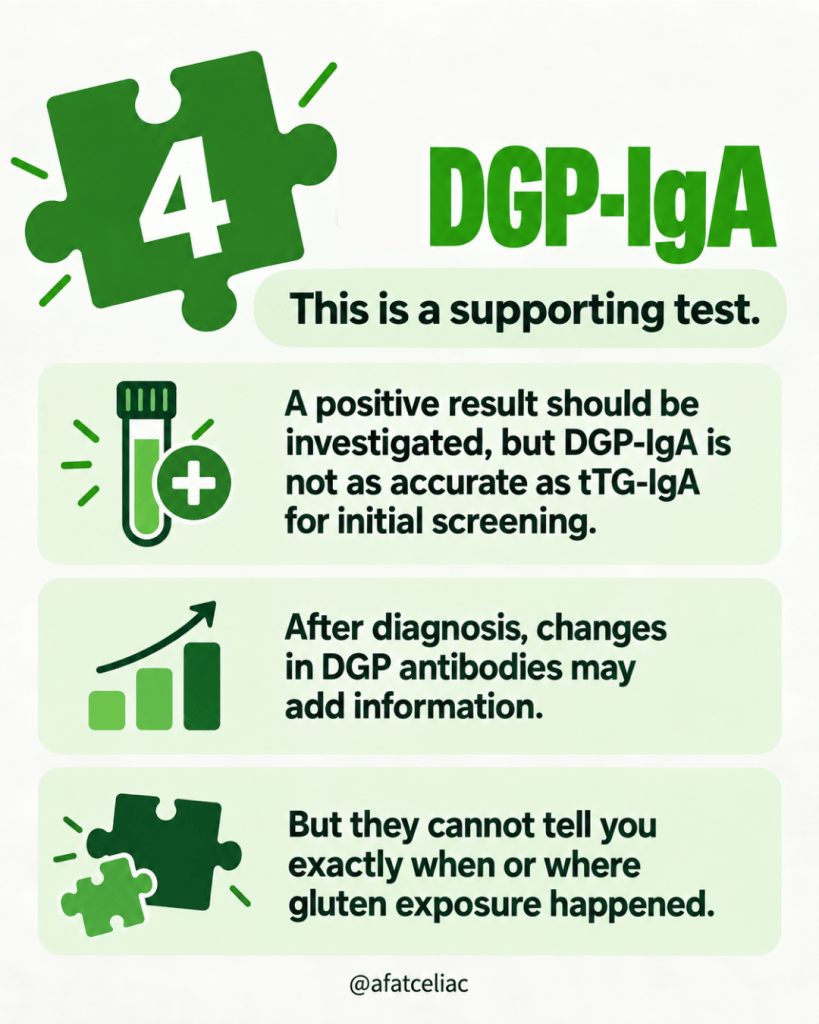
4. DGP-IgA: A supporting test
DGP-IgA can add information, but it is not as accurate as tTG-IgA for the first round of testing.
A positive result should be investigated. It should not be used by itself to diagnose celiac disease.
After diagnosis, changes in DGP antibodies may add information about how someone is responding to the gluten-free diet.
But DGP cannot tell you exactly when, where or how gluten exposure happened.
5. DGP-IgG: Context really matters
DGP-IgG can be useful when total IgA is low. It can also help in some young children.
But what if:
- Total IgA is normal
- tTG-IgA is negative
- Only DGP-IgG is positive
That pattern has a very low chance of diagnosing celiac disease by itself.
In one study, only 1 of 26 children with this pattern had celiac disease confirmed by biopsy. That is 3.9%.
That does not make DGP-IgG useless.
It means one result cannot carry the entire diagnosis.
A DGP-IgG that stays positive after diagnosis may also be a clue that the intestine is still damaged.
But it is not a real-time gluten detector. A negative result does not prove that the intestine has healed.
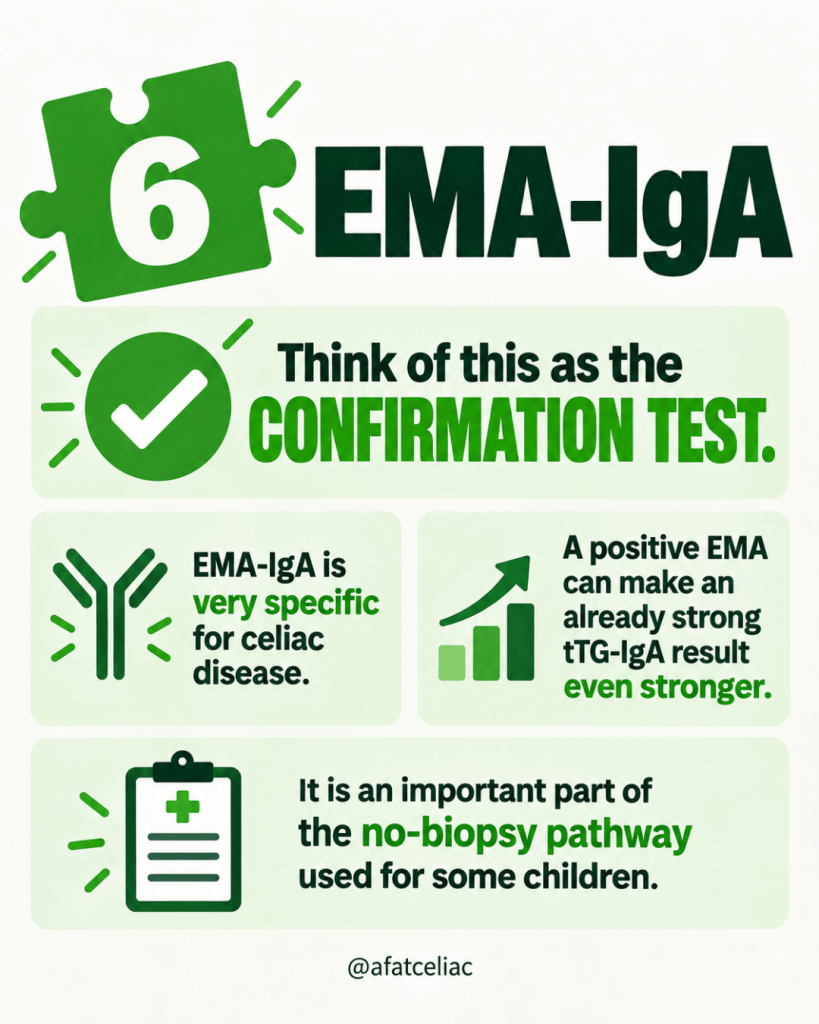
6. EMA-IgA: The confirmation test
EMA-IgA is very specific for celiac disease.
Think of it as the test that makes an already strong pattern even stronger.
If tTG-IgA is at least 10 times the upper limit of normal, a positive EMA from a second blood sample is strong evidence for celiac disease.
That combination can be used to diagnose some children without a biopsy.
For most adults, an endoscopy with biopsies is still used to confirm the diagnosis.
And one rule applies to this entire panel:
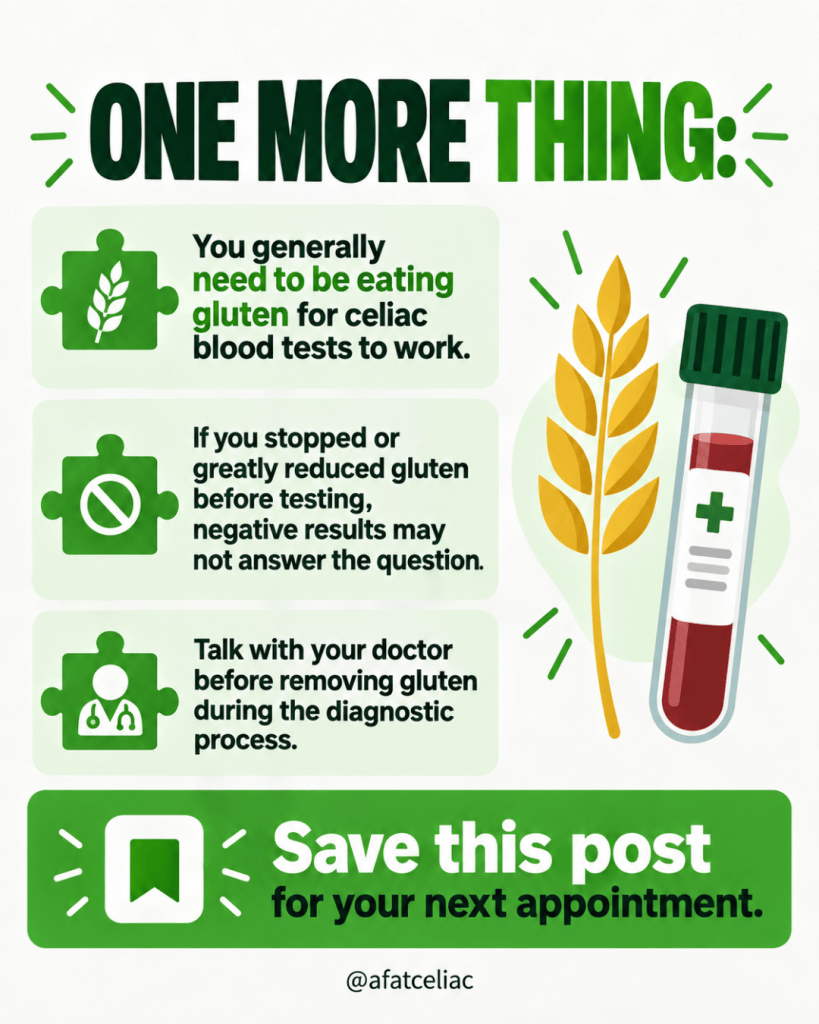
You generally need to be eating gluten for celiac blood tests to work.
If you stopped eating gluten—or greatly reduced it—before testing, negative results may not give you a useful answer.
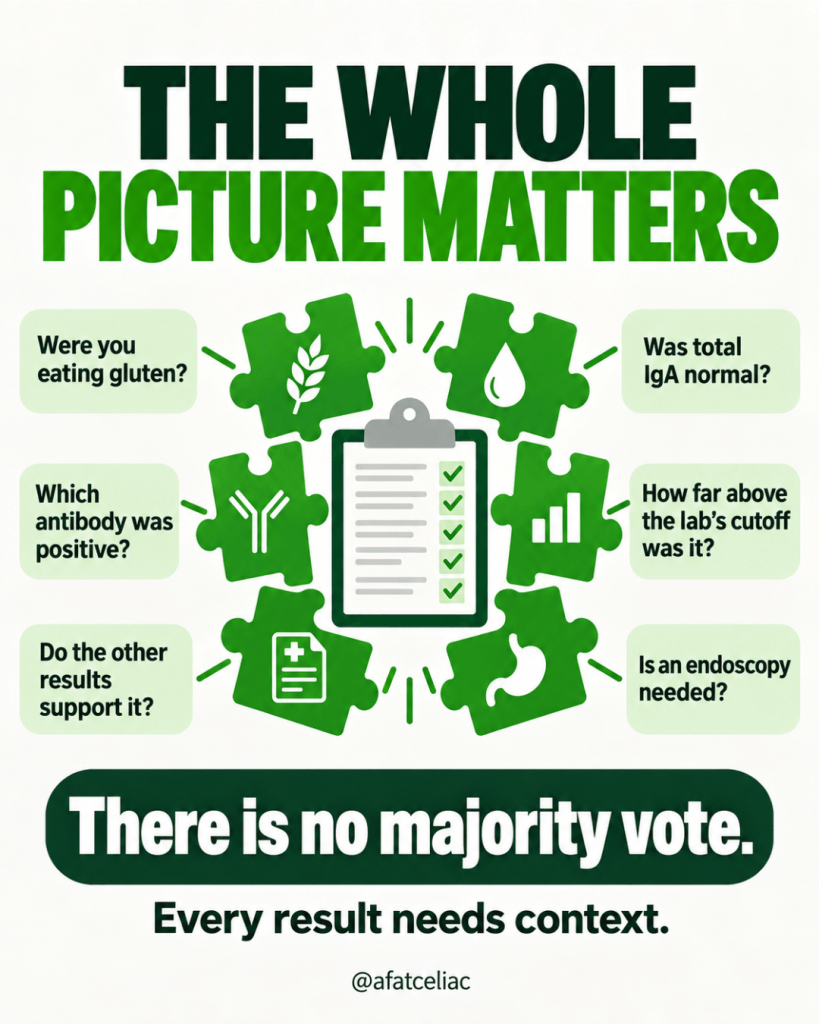
So do not read a celiac panel like this:
“Four tests were negative and two were positive, so I must not have celiac disease.”
Instead, look at the tests as a whole package⁹
Celiac blood tests are pieces of evidence with different jobs.
They are not identical boxes waiting to be counted.
Context is the test result.
Confused about what comes after a celiac diagnosis? Download Read Before You Eat, Fat Celiac’s free guide to beginning a gluten-free life with less panic and better information.
Important: This article provides general education. It cannot diagnose celiac disease or interpret your individual results. Review your testing with a qualified medical provider before beginning a gluten-free diet.
Leave a Reply