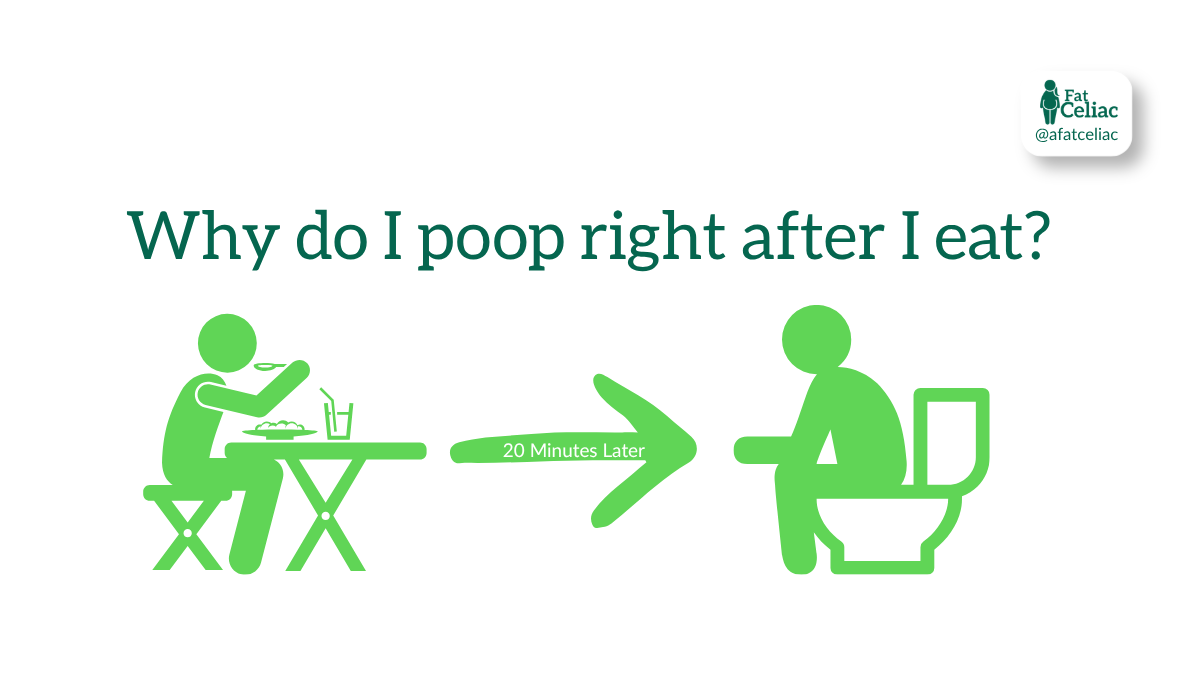

If you have celiac disease, pooping shortly after eating can feel like proof that you were glutened. But the gastrocolic reflex—and several other conditions—may explain what is actually happening.
You eat breakfast. Twenty minutes later, you’re in the bathroom.
You eat lunch. Same thing.
And if you have celiac disease, there’s a pretty easy conclusion to jump to:
Something I just ate must have had gluten in it.
Except the food you just ate probably isn’t what you’re pooping out.
What is the gastrocolic reflex?
Your digestive system has something called the gastrocolic reflex.
When food enters and stretches your stomach, your body basically tells your colon:
Hey. More stuff is coming. Make some room.
Your colon responds by contracting and moving along stool that was already farther down your digestive tract.
In other words, eating breakfast may trigger a bowel movement, but that does not mean breakfast traveled through your entire digestive system in 20 minutes.
The food entering your stomach triggered the movement of food and stool that were already farther along.
Is the gastrocolic reflex normal?
Yes. The gastrocolic reflex happens in healthy people.
Some people barely notice it. They eat, their colon gets the message and life continues.
For other people, the urge to poop after eating can be intense. It may even be strong enough that they worry they won’t make it to the bathroom.
Larger meals, higher-fat meals and caffeine can make the response more noticeable. The reflex may also feel stronger in people with gastrointestinal conditions such as irritable bowel syndrome.
But needing to poop after eating does not automatically mean something is wrong.
Sometimes your digestive system is simply doing what digestive systems do.
Does diarrhea right after eating mean I was glutened?
No. The timing alone does not prove that the meal contained gluten.
It doesn’t prove that you weren’t exposed, either.
It just isn’t enough information to know.
This is where people with celiac disease can get trapped.
We have a disease where food can hurt us, so every gastrointestinal symptom starts becoming evidence about the last thing we ate.
Restaurant Tuesday.
Diarrhea Tuesday night.
Must have been the restaurant.
Maybe.
But the timing by itself doesn’t establish that.
Symptoms are information. They are not proof of gluten exposure.
IBS and celiac disease can look remarkably similar
Diarrhea, constipation, abdominal pain, bloating, gas, urgency and changes in stool can occur with both celiac disease and IBS.
Based on symptoms alone, it may be impossible to tell the difference.
The important distinction is not necessarily how the conditions feel. It is what is causing the symptoms.
Celiac disease is an autoimmune response to gluten that can damage the lining of the small intestine. IBS is a disorder of gut-brain interaction and does not cause the characteristic intestinal damage associated with celiac disease.
Celiac disease may also cause problems outside the digestive system, including iron-deficiency anemia, nutritional deficiencies, fatigue, osteoporosis, elevated liver enzymes and dermatitis herpetiformis. But those clues are not present in everyone. Some people with celiac disease have few or no obvious symptoms.
This overlap is one reason celiac testing is recommended for people with suspected IBS and diarrhea.
It is also possible to have both celiac disease and IBS.
A celiac diagnosis does not prevent you from developing another gastrointestinal condition, and a gluten-free diet will not necessarily treat symptoms caused by something else.
What else can cause diarrhea after eating?
Diarrhea and urgency can have many possible causes, including:
- IBS
- Lactose intolerance
- Medication side effects
- Infection
- Pancreatic insufficiency
- Microscopic colitis
- Other food intolerances
- An exaggerated gastrocolic reflex
- Active celiac disease or continued gluten exposure
That list is not exhaustive, and it is not meant to help you diagnose yourself.
The point is that gluten belongs on the list for someone with celiac disease, but it is not the only possibility.
Celiac disease belongs on the list. It doesn’t get to own the list.
When should you talk to your doctor?
Occasionally needing to poop shortly after eating may simply reflect a normal gastrocolic reflex.
Persistent or worsening symptoms are different.
Talk with your doctor if you are experiencing ongoing diarrhea, severe urgency, unexplained weight loss, significant abdominal pain, blood in your stool, diarrhea that wakes you at night or symptoms that are not improving despite following a gluten-free diet.
Those details deserve investigation—not just the conclusion:
I must keep getting glutened.
If you are being evaluated for celiac disease and have not already been diagnosed, do not begin a gluten-free diet before discussing testing with your doctor. Celiac blood tests and biopsies are most accurate while you are still eating gluten.
Ask the better question
When you have celiac disease, asking “What did I eat?” makes sense.
Sometimes that is the right question.
But when symptoms are persistent, recurring or don’t fit the pattern you expect, there may be a better one:
Why is my gut doing this?
Those are two very different questions.
Understanding the difference may help you stop chasing every meal and start looking for the actual cause.
Still trying to sort out what might be celiac, what might be gluten and what question you should ask next?
Book a 30-minute Let’s Talk About It session with Fat Celiac. We’ll talk through what’s happening, identify the questions worth asking and help you determine your next steps.
Schedule your session here: https://meetings-na2.hubspot.com/fat
Leave a Reply